

Machine Hazards and Housekeeping
The two ways a machine injures you - it catches hold and pulls you in, or it closes on you - plus the environment around it and the habits that keep both off you.
Rotating machinery; Stop; Watch out
Rotating machinery
Rotating machinery injures you by catching hold of something and pulling it in. It does not have to catch your hand. It catches a sleeve, a glove, a lanyard or a strand of hair, and your hand goes wherever that goes.
Gears, pulleys and belts, chains and sprockets are extremely dangerous. Where a rotating part meets another surface there is a wedge that closes to nothing — an in-running nip point, the place the machine feeds things into itself. It is where the belt runs onto the pulley, where the chain runs onto the sprocket, where the gear teeth mesh.
The contact and the injury happen in different places. You touch the belt out in the open, where it looks like a moving strap; the belt carries you to the pulley, where there is no gap at all. That distance is why staying clear of the nip point is not enough on its own — anything the machine can grip is a handle it uses to bring you there.
What gets caught
- Loose clothing, jewelry and unsecured hair — see clothing, jewelry and hair.
- Gloves. Gloves or rags are for handling sharp objects such as cutters, and only once the machine is shut down. NEVER wear gloves at a running machine — a glove catches where bare skin would pull free, and takes your hand with it. See chips and gloves.
- A long stringy chip still connected to the cut — see Metal Chips and Swarf.
It does not take teeth, and it does not take speed. A plain smooth shaft turning slowly will still wind hair or cloth onto itself, and once it has a turn or two it does not let go.
The word for this, and where it comes from
“Nip point” is not shop slang. It is the term the machine-guarding standard uses. 29 CFR 1910.212(a)(1) requires guarding against “hazards such as those created by point of operation, ingoing nip points, rotating parts, flying chips and sparks.”
OSHA’s Machine Guarding eTool puts it plainly: “In-running nip point hazards are caused by the rotating parts on machinery.” Its longer treatment, Concepts and Techniques of Machine Safeguarding (OSHA 3067), gives three kinds:
- “Parts can rotate in opposite directions while their axes are parallel to each other. These parts may be in contact (producing a nip point) or in close proximity.” — meshing gears.
- “Nip points are also created between rotating and tangentially moving parts. Some examples would be: the point of contact between a power transmission belt and its pulley, a chain and a sprocket, and a rack and pinion.”
- “Nip points can occur between rotating and fixed parts which create a shearing, crushing, or abrading action.”
So belts, chains, sprockets and gears are rotating hazards by name. What makes them dangerous is that they draw material in — not that two parts close on each other.
OSHA is just as direct about the plain shaft: “Rotating motion can be dangerous; even smooth, slowly rotating shafts can grip hair and clothing, and through minor contact force the hand and arm into a dangerous position.”
These parts are meant to be behind covers, and the standard is specific about it — 29 CFR 1910.219(f)(3): “All sprocket wheels and chains shall be enclosed unless they are more than seven (7) feet above the floor or platform.”
The rotating parts that have no cover
Belts, gears and chains belong behind covers. The working end of a machine does not. The spindle — the driven shaft the motor turns — the chuck that grips the tool or the work, and the stock (the raw material) held in it all turn out in the open. Nothing is between you and them, because you have to reach them to do the job.
So everything above about what gets caught applies here with nothing in the way — and it applies to every machine that turns, not only the loud ones. A drill press is quiet, it is slow, and it looks like the harmless one. It is still an open chuck spinning, and it will wind hair, a sleeve or a glove onto itself like anything else. Slow is how long it takes, not whether it happens.
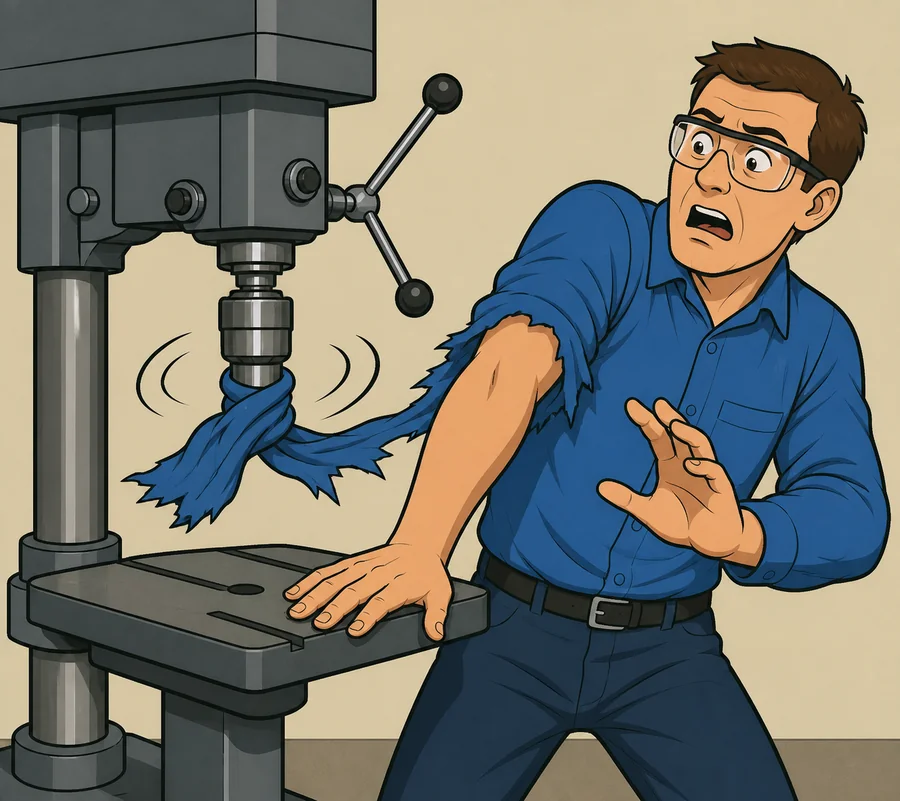
The lathe is where this goes furthest, and the reason is what a lathe is. Most machines hold the work still and move a cutter across it; a lathe does the opposite and turns the work. What is spinning in the open is then not a bit the width of a pencil — it is the whole part, as long and as heavy as that part happens to be. That is why the fatality reports for lathes describe something other than a hand injury: a person wound onto their own workpiece.
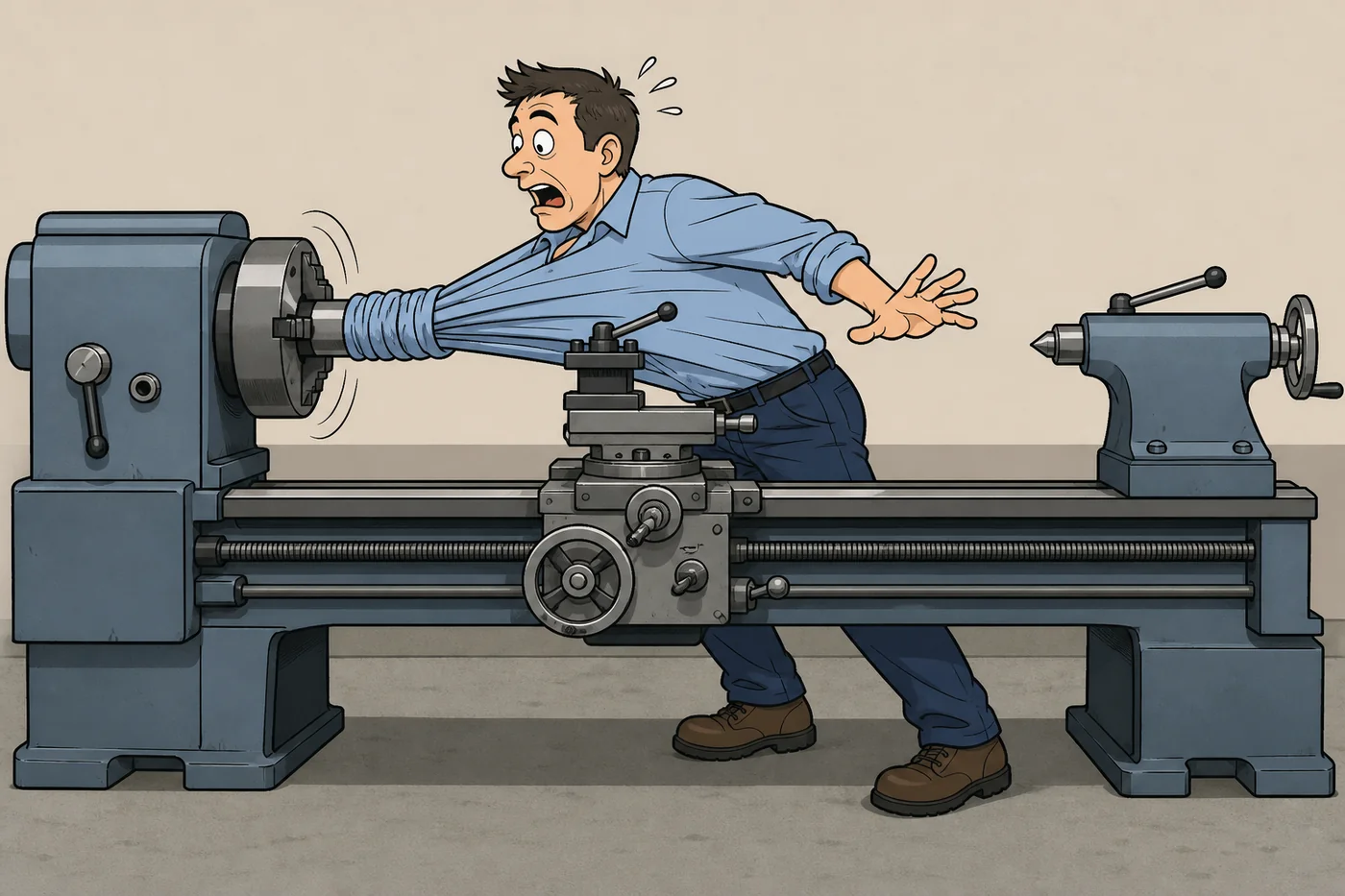
The question, before anything is switched on: what is turning, and what of mine can reach it? A sleeve, a glove, loose hair and a strip of abrasive cloth held against the work have each pulled somebody into a machine. Every one of them is easier to deal with before the spindle is turning than after.
None of this is a ranking. The mechanism is the same on every machine that turns, and the one that can catch you is whichever one you are standing at.
What the investigations actually describe
Oregon’s state fatality-investigation program, summarizing the record for this class of machine: “The most common causes of death and injury from metal lathes include entanglement of clothing in moving parts, being hit by loose objects on the lathe (e.g., chuck keys, tools, metal shavings) and being struck by a part that has not been adequately secured.” (OR-FACE 2012-18-1, Experienced Journeyman Machinist Killed While Operating an Engine Lathe, 2014.)
Four investigated deaths, all the same event — something attached to a person touched something turning, and the machine did the rest:
- Smoothing a part while it turned. A 69-year-old machinist with over 30 years’ experience “reached over the work piece to smooth out a radiused transition with emery cloth and a file in hand” and “his loose clothing (left arm sleeve) became entangled around the rotating work piece”. A co-worker 30 feet away heard “a strange ‘winding-up’ sound”. Of that same part, the shop foreman had said that “the rough surface could grab clothing or gloves”. (OR-FACE 2012-18-1.)
- Stock sticking out the back of the spindle. A 52-year-old machinist was set up on a 103-inch steel bar: “Due to the length of the material, 24 inches were sticking out the back of the lathe, unguarded, and held in place with a clamping device that rotates as the lathe rotates.” He reached across the running machine and “the sleeve of his shirt became entangled”. (Kentucky FACE 21KY002, 2021.)
- A burr on the end of the bar. A lathe operator in his twenties had a 1 7/8-inch stub of 1-inch bar standing past the tailstock. “The right pocket of his shirt was caught by the rotating tailstock burr. His shirt wrapped around the stock and tightened at the decedent’s neck and chest.” The listed contributing factor is “walking to and/or reaching over unguarded rotating bar stock”. OSHA makes the same point in general: the danger “increases when projections such as set screws, bolts, nicks, abrasions, and projecting keys… are exposed on rotating parts.” (Michigan FACE 14MI034, 2014; OSHA Machine Guarding eTool.)
- A drill press. “As Employee #1 reached into the unguarded point of operation, his shirt sleeve or gloves became entangled in the drill bit. Employee #1 was pulled toward the machine, entangling Employee #1’s long hair. The drill press continued to spin, completely pulling Employee #1 into the operating area.” She died of her injuries. The same report records that the spindle “had speeds that ranged from 45 to 1115 rotations per minute”. (OSHA accident 114097.015, 20 February 2019.)
Why abrasive cloth keeps appearing. The UK Health and Safety Executive publishes a sheet on this one task: “Every year there are serious accidents involving the use of emery cloth on metalworking lathes. These accidents result in serious injuries such as broken bones, dislocations, lacerations, amputations and occasionally death.” The mechanism it names is the one above: “Accidents occur when hand-held emery cloth is entangled in the rotating parts of the machine or where the emery cloth is snagged on the rotating component dragging the operator into the danger zone.” Its own rules are that emery cloth “should NEVER be applied directly by hand on manual metalworking lathes”, and that gloves “increase the risk of entanglement and” are “never acceptable near rotating parts of machinery”. (HSE Engineering Information Sheet No 2, rev 1, 2015 — that is HSE’s guidance; ask what the procedure is in the shop you are standing in.)
And the drill press is not the exception it looks like. OSHA’s own drill-press training script lists, among the ways accidents happen, “getting dangling jewelry, loose clothing, or hair caught in the drill chuck (rotational hazard)”, and states: “The primary hazards of drill presses are contact at the point of operation and rotational hazards. An operator can risk serious hand injury when working too close to the drilling area, wearing gloves, loose clothing, loose hair, or jewelry.”
Moving machinery and pinch points; Watch out
Moving machinery and pinch points
Moving machinery injures you without ever catching hold of you. Two surfaces close on each other with you in between. Nothing pulls you anywhere — you run out of room.
What makes a pinch point
A pinch point is a gap that is closing: two parts, at least one of them moving, with space between them that is on its way to nothing. That is the whole of it, and it is why pinch points are hard to spot. There are no teeth, no edge and often no noise. A wide gap and a narrow gap look the same until the last inch, and the gap does not care what is in it.
Two kinds of movement, and both make one:
- Back and forth, up and down
- A press ram, a drill head coming down, a saw guide being lowered, a clamp closing. You are caught between the part that moves and the part that does not.
- Straight along
- A table, a carriage or a saddle travelling. It closes the gap against whatever waits at the end of its travel — a stop, a column, the machine’s own frame, or the hand resting there.
Where they hide
- Between the work and whatever holds it. A vise jaw, a clamp, a fixture: the hand steadying the workpiece is inside the gap that is closing on the workpiece.
- At the end of a table’s travel. Wind it far enough and the space between the table and the frame goes to zero, with whatever was resting there in between.
- Under anything that comes down. A head, a ram, a guard, a guide.
- On hinges. Covers, doors and lids close on their own frames — at the free edge, where a hand is holding them, and again right at the hinge, where the gap closes over almost no distance at all.
A pinch point needs no power, no speed and no noise. A vise turned by hand multiplies what you put into the handle many times over, and it closes slowly and quietly enough that nothing warns you. Switching a machine off removes the part that would have closed the gap for you. It does not remove the gap.
The question to ask
Before moving anything — a handwheel, a lever, a clamp, a guard — what closes, and what is in the way? Follow the moving part to the end of its travel and find what it meets there. Then look at where your hands are, and where they will still be once you are watching the cut instead of watching your hands.
Why belts and chains count as rotating, not pinching
OSHA sorts machine hazards by the motion that causes them, and “pinch point” is the vocabulary it attaches to parts that travel, not to parts that turn. From Concepts and Techniques of Machine Safeguarding (OSHA 3067):
- Reciprocating motion — “Reciprocating motions may be hazardous because, during the back-and-forth or up-and-down motion, a worker may be struck by or caught between a moving and a stationary part.”
- Transverse motion, which means movement in a straight continuous line — “Transverse motion (movement in a straight, continuous line) creates a hazard because a worker may be struck or caught in a pinch or shear point by the moving part.”
A belt on a pulley is a rotating hazard that draws material in; a table running up against a column is a moving hazard that closes on it. Both can take a hand, and the vocabulary is worth keeping straight because the two do not have the same tell. You avoid the first by giving it nothing to grip. You avoid the second by knowing where the gap is going.
Guards stay on, and taking one off is not your call; Stop
Guards stay on, and taking one off is not your call
A guard is the thing standing between you and everything the two sections above describe. It is not an accessory, and it is not in your way — it is doing the one job nothing else on the machine does.
No one removes a guard in this lab. A machine that needs a guard off is the instructor’s to deal with, out of class.
That is the whole rule, and it is deliberately not a judgement call. You do not have to decide whether this particular setup is the exception, whether the cut is short enough, or whether you will be careful. If the guard is in the way, the answer is to stop and say so — not to work out whether you can manage without it.
It also means a machine you find with a guard already missing is not ready to use. Say something. You have not done anything wrong by finding it that way, and the person who uses it after you has no way of knowing.
Why the rule has no exceptions in it
Guarding is not a local preference. 29 CFR 1910.212(a)(1) — quoted already in Rotating machinery above for its definition of a nip point — is a guarding requirement first: one or more methods of machine guarding shall be provided to protect the operator and other employees from hazards including those created by point of operation, ingoing nip points, rotating parts, flying chips and sparks.
The reason a rule like this is written without exceptions is that the exceptions are exactly where people get hurt. A guard comes off for a legitimate setup, the setup takes longer than expected, somebody else walks up to a machine that looks normal and is not. The standard's own answer to “but this task genuinely needs the guard off” is not a more careful operator — it is Lockout/Tagout, the next card on this page, which is a procedure rather than a permission.
Lockout/Tagout — before anyone works on a machine; Stop
Lockout/Tagout — before anyone works on a machine
Everything on a machine that turns or travels does so because something is powering it. Lockout/Tagout is how that power is taken away and kept away while somebody works on the machine.
NEVER work on equipment with rotating or moving parts without first disconnecting power.
Lockout/Tagout procedures must be followed for maintenance.
The two words
- Lockout
- A lock on the device that isolates the energy — the disconnect, the breaker, the valve — so it physically cannot be switched back on.
- Tagout
- A tag on that same device saying who put it there and why, so nobody removes it wondering.
Off is not disconnected, and disconnected is not still
- Off is not disconnected. A machine’s own on/off switch is a control. Someone can press it back on, and either way the machine is still connected to its supply. The disconnect is the thing that gets locked.
- Disconnected is not still. A spindle coasts. A raised head or ram drops. A spring, a charged capacitor or air still in a line will all move something after the power is gone. Energy already inside the machine is part of what the procedure has to deal with.
What the standard actually covers
29 CFR 1910.147(a)(1)(i): “This standard covers the servicing and maintenance of machines and equipment in which the unexpected energization or start up of the machines or equipment, or release of stored energy could cause injury to employees.”
Two things are worth reading twice. Unexpected is the whole point — the hazard is not that the machine runs, it is that it runs while someone has a hand inside it. And stored energy is named alongside energization, because a machine that has been switched off and unplugged can still contain everything it needs to move once.
“Servicing and maintenance” is much broader than it sounds. The standard defines it as “constructing, installing, setting up, adjusting, inspecting, modifying, and maintaining and/or servicing machines or equipment”, and adds: “These activities include lubrication, cleaning or unjamming of machines or equipment and making adjustments or tool changes, where the employee may be exposed to the unexpected energization or startup of the equipment or release of hazardous energy.” Setting up, clearing a jam and changing a tool are all on that list.
Stored energy gets its own requirement — 1910.147(d)(5)(i): “Following the application of lockout or tagout devices to energy isolating devices, all potentially hazardous stored or residual energy shall be relieved, disconnected, restrained, and otherwise rendered safe.” The lock comes first, and then the energy already in the machine is dealt with. Both, in that order.
The environment around the machine
- Slip hazards
- Clean dust, metal chips, water and coolant off the floor immediately.
- Lighting
- Ensure lighting is adequate before operating any machine.
- Walkways
- Keep aisles and emergency exits unobstructed.
Operating habits
Operating habits
- The chuck key never leaves your hand. It is not released until it is out of the chuck. There is no moment where the key is in the chuck and not in your grip — not to reach for something, not to answer someone, not for a second.
- Stop machines completely before taking measurements or making adjustments.
- Secure all workpieces before operation — use clamps, vises or fixtures.
- Never leave tools on or near operating machinery.
Why the chuck key rule is worded as a grip and not as a reminder
A key left in a chuck is launched the instant the machine starts. Written as “remember to remove the key” the rule depends on you remembering at the one moment you are busy with something else; written as the key never leaves your hand there is nothing to remember, because a key that is still in the chuck is still in your hand and you cannot start the machine.
Do not let a spring be the thing that saves you. Some chuck keys are spring-loaded and eject themselves when you let go — ours are, on the lathe. Not all keys are, and our Jacobs chuck keys are not. So the habit has to be the same on every machine, or it is a habit that works until you walk up to a different chuck.
A drill-press chuck key is lighter than a lathe chuck key and carries far less energy. It is still dangerous: it is in the list of things that become projectiles in Rotating machinery above, and “less mass” is not the same as “will not hurt you” when it leaves a spinning chuck at the distance you are standing.
The shutdown and cleaning steps that close every session are in After operating any equipment.