

Murray State University School of Engineering CourseWiki
CourseWiki/Safety/Universal Rules

Electrical Safety

Why 50 V is a workplace control threshold, why 5 V can still burn you, the inspection required before every use, cords on the floor, and what to do when someone is shocked.

Electrical Sources

Electrical Sources

What hurts you at 5 V is not what hurts you at 240 V; one is a burn hazard while the other is a shock hazard.

5 V / 12 V
The power supply on the bench, batteries, and the battery pack out of a cordless drill. Lower shock risk, not a magic cutoff. Not below the burn threshold.
120 V
Wall outlets. Dangerous — can cause serious injury or death.
240 V / 480 V
Industrial equipment. Extremely dangerous — often fatal.

Voltage tells you whether a circuit can push current through you. It does not tell you what that circuit can do to a ring, a dropped tool or a shorted cell.

Those are two different hazards with two different thresholds. The next two sections are about how each hazard changes.

Electrical — Shock Hazard; Stop

Electrical — Shock Hazard

There is no magic voltage at which shock suddenly becomes possible. A shock can be painful without being life-threatening, and its severity depends on current, path, duration, and your body’s resistance. Higher voltage can drive more current through the body, so the risk of serious injury rises with it. In U.S. workplace rules, 50 volts is a common control threshold: at or above it, live parts must be guarded and work near exposed live parts requires specific controls.

  • OSHA requires live parts to be de-energized before you work on or near them — and then says that “live parts that operate at less than 50 volts to ground need not be deenergized if there will be no increased exposure to electrical burns or to explosion due to electric arcs” (29 CFR 1910.333(a)(1)). Read that second half again; the rest of this page hangs on it.
  • At or above the line, live parts must be guarded against accidental contact. The rule is written for “electric equipment operating at 50 volts or more” (29 CFR 1910.303(g)(2)(i)).
  • That number applies to DC as well as AC. The standard does not distinguish between them, and OSHA has stated it “considers all voltages of 50 volts or above to be hazardous” (interpretation letter, 4 September 2015).
  • NFPA 70E draws the same line. Below 50 V you may work live only where the capacity of the source and any overcurrent protection have been considered and found not to add burn or arc exposure (2024 edition, 110.2(B) Exception No. 5).
“It’s not the voltage that gets you, it’s the current”

The saying is true. What usually gets taken from it — that the voltage does not matter — is not. Current is electricity actually moving through you, and it takes very little of it to do real harm. Volts sitting on a wire nobody is touching do nothing at all.

Two things together decide how much current you get: how hard the electricity is being pushed, which is what voltage measures, and how hard your body holds it back, which is called resistance. Harder push, more current. More resistance, less.

Your resistance is not a fixed number — wet skin holds current back far less than dry skin does, so the same push moves much more current through you. That half of it cannot be relied on, which is why the line is drawn on the half that can be: the push.

The international standards are not one number

On datasheets you will meet a different set of figures, and there the AC and DC limits are not the same:

50 V AC / 120 V DC
Extra-Low Voltage under IEC 61140 and IEC 60364-4-41 — 50 V AC rms, or 120 V ripple-free DC. “Ripple-free” is a real condition, not a figure of speech: past roughly 10 % rms ripple the supply is treated as AC and the lower number applies.
30 V AC / 60 V DC
Class ES1 in IEC 62368-1, the standard behind most benchtop and consumer equipment. ES1 is the class that needs no safeguard at all; ES2 runs up to 50 V AC / 120 V DC and requires one.

In this lab, use 50 V — AC or DC. It is the number OSHA enforces, it is the most conservative of the figures above, and it assumes nothing about your skin being dry or your hands being clean. If a circuit is at or above 50 V, it is not something you work on live.

Electrical — Burn Hazard; Stop

Electrical — Burn Hazard

Below 50 V, the primary concern often shifts from shock to short-circuit current. This is the half of the page people get wrong, because the voltage people assume is harmless is the one nobody is careful with.

Look at what the exemption above is actually conditioned on. Not shock — burns and arcs. NFPA 70E names the same condition as the capacity of the source. Both standards are telling you that once you are under that workplace control threshold, the question changes from how many volts to how many amps can this thing deliver into a dead short.

Where the current comes from

  • A bench supply set to 5 V will deliver its full rated current into a short without complaint. That is what the current limit is for — and if you have wound the limit up to get a motor turning, you have wound the protection off.
  • A lithium cell or pack has almost no internal resistance. Shorted, a single cell can dump tens of amps within milliseconds. A pack does considerably worse.
  • A lead-acid battery is rated in hundreds of cold-cranking amps — and that is a 30-second load test, not a ceiling. A dead short pulls far more.

None of these can push meaningful current through your body at 12 V. All of them can push hundreds of amps through a piece of metal — and metal carrying current it was never sized for gets hot, fast.

Metal jewelry is the classic way this happens

ALL jewelry is already PROHIBITED here — see clothing and jewelry. That rule was written for rotating machinery. It earns its keep a second time on the bench, and OSHA writes it a second time for exactly this reason: conductive jewelry “may not be worn if they might contact exposed energized parts” (29 CFR 1910.333(c)(8)) — a rule that states no voltage floor. The same sentence gives the way out: such articles may be worn if they are “rendered nonconductive by covering, wrapping, or other insulating means.”

A ring or a metal watch band bridging a low-voltage source is a near-zero-resistance path across something that can supply hundreds of amps. The ring becomes the heating element. This is documented injury, not a story: a mechanic’s gold ring touched the positive terminal of a 12 V car battery while the wrench in his hand bridged the ring and the negative terminal, and the result was a deep circumferential burn around the base of the finger that needed a skin graft. A review of nine ring burns at one burn center found the same pattern: the small size of the burn hides how bad it is, because a burn that wraps a finger is far more likely to need grafting and to leave lasting loss of function than a burn of the same area anywhere else.

You can drop a wrench. You cannot drop a ring.

The silicone wedding ring that the PPE rule allows is also the right answer electrically: silicone does not conduct, so it cannot become the short.

A shorted lithium cell does not just get warm

An external short is one of the recognized triggers for thermal runaway — the cell generates heat faster than it can shed it, and the outcome is “extremely high temperatures, violent cell venting, smoke and fire” (UL Research Institutes). Once it has started, disconnecting it does not stop it. The cell is now its own energy source.

NEVER leave loose cells or packs where metal can bridge the terminals — a drawer with tools in it, a pocket with keys in it, a bin with offcuts in it. Federal transport rules require lithium cells and batteries to be packed so their terminals cannot short (49 CFR 173.185). The reason that rule exists is the reason to do the same thing on your own bench.

A cell that has been shorted, dropped, crushed, punctured or has swollen is out of service. Tell the instructor. Do not put it back on charge to find out. See Fire Safety.

The sentence to take away: low voltage does not mean low energy. Voltage helps determine whether a circuit can shock you. Current decides whether it can burn you — and current is set by what the source can deliver and what is in the path, not by the number printed on the front of the supply.

Electrical Conductors; Stop; Watch out; Checklist

Electrical Conductors

Inspect every cord, every time, before it goes into the receptacle. Never run your hand along a cord while it is plugged in; that is a dangerous way to find fraying. It takes about five seconds, and it is the one check that catches most of this page before it happens rather than after.

  • With the cord unplugged, run it through your hand end to end. Look for frayed, cracked, cut or exposed insulation, and for flat spots where something has been driven over it.
  • Check the plug: blades all present, straight, tight in the body, not discolored or pitted. Check the ground pin is still there — a missing ground pin means the cord is out of service, not that you have found a workaround.
  • Check where the cord enters the plug and enters the tool. That is where flexing breaks conductors, and it is where the damage hides.
  • Inspect extension cords for cuts, crushing and wear, and check the receptacle end for scorching or melted plastic.
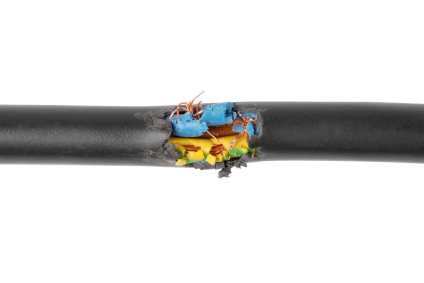
A power cord with its outer jacket split open across the middle, exposing the colored insulation of the conductors inside and the frayed shielding around them.

Damage like this means the cord is finished, not that it needs watching.

If you find damage, stop, unplug it, and notify the instructor. Not “just for this one cut”. Tag it or hand it over, so the next person does not find it the hard way.

Tape is not a repair. OSHA allows electrical tape over superficial scuffs in the outer jacket, and has stated just as plainly that “tape repairs of the jacket may not be used to bring a worn or frayed flexible cord into compliance” (interpretation letter, 16 December 1998). If conductors or their insulation are showing, the cord is done.

Connections and plugs

  • Always disconnect power before performing any maintenance or adjustment.
  • NEVER yank or pull a cord — grasp the plug, not the cord. Pulling by the cord wrecks the strain relief where you cannot see it, and it is how a plug ends up half out of the receptacle with the blades exposed.
  • Push a plug fully home, and look at it. A plug that will not seat is a fault to report, not a fit problem to force.
  • Keep electrical connections away from water and wet surfaces. Wet skin has on the order of 1,000 ohms of resistance where dry skin has 100,000 ohms or more, so water moves you roughly a hundredfold closer to the current every rule on this page is trying to keep out of you.
  • Be aware of overhead wiring when you are handling long stock, moving a ladder or lifting.

A partly unplugged appliance is a short waiting for something to land on it

  1. Plug fully seated A plug is fully seated in a wall receptacle. No metal blades are exposed. 1 FULLY IN NO EXPOSED BLADES
  2. Plug pulled partly out The same plug is pulled halfway out of the wall receptacle, leaving both metal blades exposed in the gap. 2 EXPOSED GAP BLADES ARE LIVE
  3. Metal chip bridges exposed blades A metal chip falls across the two exposed blades and short-circuits the supply. A flash marks the contact point. 3 CHIP BRIDGE DEAD SHORT
The hazard is the gap, and it is there before anything lands in it.

Exposed blades sit at full line voltage with nothing between them but air. Anything conductive that falls across them completes the circuit straight across the supply — and in a shop, the thing that falls is a metal chip. What follows is not a shock. It is a dead short: a bang, a hard flash, and enough heat at the contact point to weld and pit the blades. It will very likely trip the breaker and it can wreck the outlet or whatever is plugged into it. The breaker protects the wiring, not your face, and it does not act until after the flash.

Plugs are all the way in or all the way out. Nothing in between, and nothing left in between.

Chips travel further than you expect and they conduct — see Metal Chips and Swarf. That is the direct line between the housekeeping rules and this one.

Lockout/Tagout for machinery with moving or rotating parts is covered in Machine Hazards and Housekeeping.

Cords on the floor — the one most likely to get you; Stop; Checklist

Cords on the floor — the one most likely to get you

Nothing else on this page is as likely to actually injure someone as a cord lying across a walkway. It is not a shock hazard at all. It is a trip hazard — and a trip in a shop is not a trip onto carpet. You land on concrete, or into a machine, or on something sharp.

The regulation treats this as a floor problem rather than an electrical one: “walking-working surfaces are maintained free of hazards such as sharp or protruding objects, loose boards, corrosion, leaks, spills, snow, and ice” (29 CFR 1910.22(a)(3)), and passageways and work areas are kept “in a clean, orderly, and sanitary condition” (29 CFR 1910.22(a)(1)). A cord across an aisle is an obstruction in an aisle.

A person mid-stumble in a shop, one foot caught in a coiled yellow extension cord run across an open concrete walkway, both hands thrown out to break the fall.

A trip in a shop is not a trip onto carpet. You land where the machines are.
The correct route is longer and costs nothing. That is the whole argument.

What to do, in order of preference

  • Do not cross the walkway. Move the work to the outlet, or use a different outlet. This is almost always available, and it is almost never the first thing anyone tries.
  • Route along the wall or the bench line rather than across open floor. Take the long way around the edge of the room.
  • Go overhead where a drop or a reel is provided. That is what they are for.
  • If it genuinely must cross, cover or anchor it. OSHA’s own guidance is to “ensure that temporary electrical cords that cross aisles are taped or anchored to the floor”. A cord ramp or cord cover does the same job better and protects the cord as well as the person.
  • Use the shortest cord that reaches. Slack on the floor is the hazard, and a coiled surplus in a walkway is the same hazard in a tighter package.
  • Unplug it and put it away when you are done, in the same movement as shutting the tool down. The cord left out after the job is finished is the one nobody is expecting.

PROHIBITED — running a flexible cord through a doorway, a window, or a hole in a wall, ceiling or floor, and attaching it to building surfaces. Those are named prohibitions in the electrical standard (29 CFR 1910.305(g)(1)(iv)), along with using flexible cord as a substitute for the fixed wiring of a building. Flexible cord is temporary by definition. A cord treated as permanent gets pinched, crushed and forgotten.

NEVER walk past a cord lying across a walkway and leave it because it is not yours. If you can see it, you can move it or say something. The person who trips over it will not have seen it.

Read from the cord’s side, the rule is the same: portable equipment must be handled so it is not damaged, and every cord set must be inspected before use on any shift for cuts, crushing and a pinched jacket (29 CFR 1910.334(a)). A cord that gets walked on is a cord that fails the inspection above. This section and that one are the same problem twice.

Keeping walkways clear is the Set in Order and Shine part of 5S. The safety case and the lean case are the same case.

If someone is shocked; Stop; Watch out

If someone is shocked

Do NOT touch them directly. If current is still flowing they are part of the circuit, and grabbing them puts you in it as well.

  • Kill the power first — the machine switch, the disconnect, the breaker, or pull the plug.
  • If you cannot kill it, use a dry, non-conductive object to separate them from the source, and stand on something dry while you do it.
  • Then call for help and start first aid.

Call 911 and notify the instructor — follow emergency procedure.

A small mark is not evidence of a small injury. Electrical and electrothermal burns run deep with very little to see on the surface, and a burn that wraps a finger can cost the use of it. Any shock, and any electrical burn, gets reported and gets looked at — however fine the person says they are.